
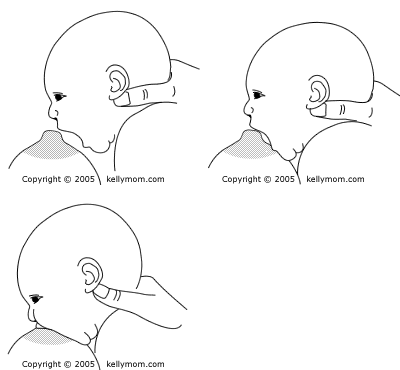
 No matter what latch and positioning look like, the true measure is in the answers to these two questions:
- Is it effective?
- Is it comfortable?
Even if latch and positioning look perfect (and, yes, even if a lactation consultant told you they were fine), pain (particularly after the first two weeks) and/or ineffective milk transfer indicate that something needs to change, and the first suspect is ineffective latch/positioning.
If baby is transferring milk and gaining weight well, and mom is not hurting, then latch and positioning are – by definition – good, even if they look nothing like the “textbook” latch and positioning that you’ve seen in books.
Now infants can get
all their vitamin D
from their mothers’ milk;
no drops needed with
our sponsor's
TheraNatal Lactation Complete
by THERALOGIX. Use PRC code “KELLY” for a special discount!
“Rules and regulations have no place in the mother-baby relationship. Each mother and baby dyad is different and what works well for one mother and baby may not work well for another mother and baby. The important thing to do is to look at the mother and baby as individuals.”– Andrea Eastman, MA, CCE, IBCLC in The Mother-Baby Dance
Following are some of my favorite resources on latch and positioning:
Newborn Hands: Why are they always in the way while breastfeeding? from the San Diego Breastfeeding Center
Latching handouts by Diane Wiessinger, MS, IBCLC
Breastfeeding: Off to the best start from the Unicef UK Baby Friendly Initiative
(Lovely latching pictures here, with simple directions. Open (download) the leaflet from the link.)
Deep Latch Technique from The Pump Station.
(Good latching pictures and directions.)
When Latching by Anne J. Barnes, has instructions with drawings
(The drawings and tips here are helpful.)
A Guide to Latching Your Baby by CW Genna

Jessica Merz cc flickr
(with photos)
 Breastfeeding Videos by Dr. Jack Newman
Animation illustrating assymetrical latch technique by Victoria Nesterova
(Nice animation — text is in Russian.)
Is baby latching on and sucking efficiently? How to tell from AskDrSears.com
(A useful list.)
Help for various nursing positions
Some Ins and Outs of Laid-Back Breastfeeding from Nancy Mohrbacher
Laid back breastfeeding video from BiologicalNurturing.com
Lactation yoga, or side-lying nursing without getting up to switch sides by Eva Lyford, @ 
Nursing Laying Down (step-by-step description with photos) from Mother-to-Mother.com
More useful information
Latching: Thoughts on pushing baby’s chin down when latching @
Baby Led Latching from Natural Mama NZ
Everything Old is New Again by Diane Wiessinger, MS, IBCLC
When The Breastfeeding Baby Keeps Falling Asleep Before They’re Full from Analytical Armadillo
Videos: Breastfeeding NZ — A Good Latch
When the Back of the Baby’s Head is Held to Attach the Baby to the Breast by Robyn Noble DMLT, BAppSc(MedSc), IBCLC and Anne Bovey, BspThy
Breast Compression by Jack Newman, MD. The purpose of breast compression is to continue the flow of milk to the baby once the baby no longer drinks on his own, and thus keep him drinking milk. Breast compression simulates a letdown reflex and often stimulates a natural let-down reflex to occur. The technique may be useful for poor weight gain in the baby, colic in the breastfed baby, frequent feedings and/or long feedings, sore nipples in the mother, recurrent blocked ducts and/or mastitis, encouraging the baby who falls asleep quickly to continue drinking.